

The Motivation Barometer
The Motivation Barometer was an ongoing research initiative designed to monitor and assess the motivation of the Belgian population during the COVID-19 crisis. It aimed to understand how people's motivation evolves in response to public health measures and how psychological factors influenced their adherence to these measures over time.
In practice, the Motivation Barometer helped to inform public policy and communication strategies by offering evidence-based recommendations to government officials, crisis centers, and the media. It highlighted the importance of maintaining the population’s motivation, not just for compliance, but also for mental well-being, and it aimed to bridge the gap between psychological theory and real-world practice.
Through reports and interventions in various media, the findings from the Motivation Barometer have been used to advise governments and institutions on how to sustain public motivation, ensuring that measures are proportionate, communicated effectively, and take into account the population's mental health.


How it started
The emergence of the SARS-CoV-2 virus required a swift and coordinated response from policymakers to control its spread (World Health Organization, 2020). Policymakers worldwide sought advice from scientific advisory committees, mainly composed of biomedical experts, including virologists, infectious disease specialists, biostatisticians, and epidemiologists. Although individuals’ behavior and adherence to health guidelines are critical in controlling the virus, social scientists, particularly psychologists, were notably underrepresented in advising policymakers with evidence-informed recommendations (Bavel et al. 2020).
Policy decisions, although essential for containing the virus, can often be intrusive into people’s lives and conflict with basic psychological needs, such as the need for relatedness (Leary 2022; Ryan and Deci 2017). The unpredictable course of the virus, coupled with the absence of efficient vaccines in 2020 and the gradual vaccine rollout until mid-2021, demanded prolonged adherence efforts from citizens.
The Motivation Barometer project was established to contribute to evidence-based COVID-19 policy and address various psychological aspects affecting individuals. This large-scale, dynamic monitoring system tracked psychological functioning across the pandemic through over a hundred measurement waves, starting on March 19, 2020, one day after Belgium’s initial lockdown. The project originated in the Belgian context, but its generic aspects hold relevance for other countries.


Method and analytical approach
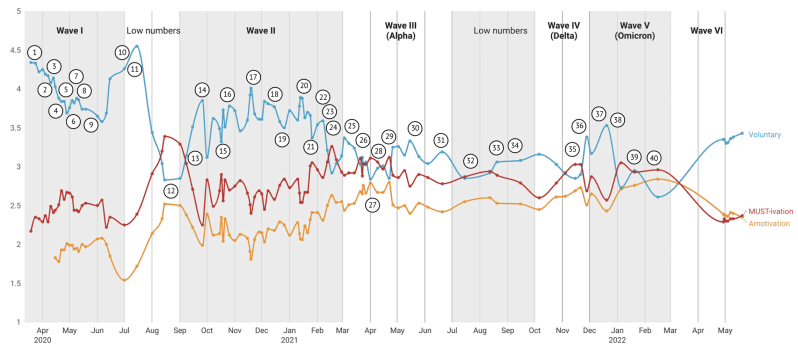
Overview reports on fluctuations in motivation over time
Initially launched in Flanders, the Motivation Barometer expanded to include French language questionnaires and participants from Brussels and Wallonia. Participants were recruited online through social media ads and collaborations with national newspapers. No monetary incentives were provided. A total of 483,778 surveys were completed by 321,495 unique individuals across 110 waves, with an average of 2949 participants per wave. Ad hoc recruitment led to nonrepresentative data, biased towards those with computer and internet access, and motivated individuals. The sample was older, more female, more vaccinated, and more educated than the average Belgian population. To address bias, a weighting procedure was applied based on population statistics, though limitations were acknowledged. Attitudinal data were cautiously presented, and a weighting procedure adjusted for sociodemographic differences. Nonetheless, potential biases and limitations in small datasets were recognized, and the influence of other unmeasured variables on self-selection was acknowledged.
To address potential biases, our analysis and presentation of findings focused on structural relations between psychological variables or between sociodemographic and psychological factors, minimizing the impact of data unrepresentativeness. Rather than reporting absolute numbers, we emphasized relative changes over time and presented findings in a differentiated manner for characteristics not included in the weighting procedure. Careful wording and theory-grounded interpretations were employed to prevent inappropriate conclusions and aid understanding among citizens and policymakers.